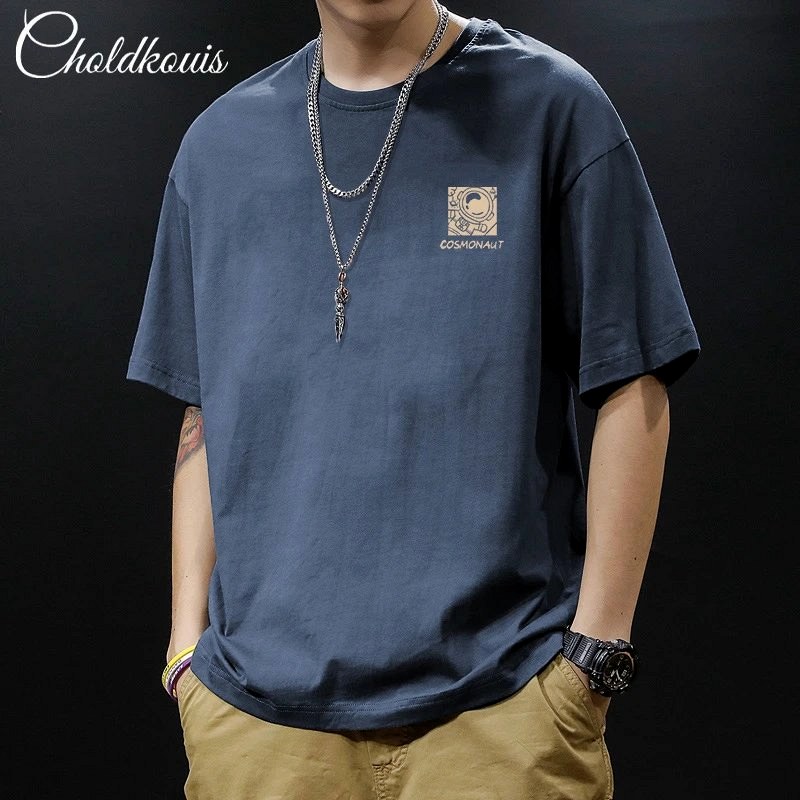
What arrived on the bench
Our parcel contained the Foreign Trade crewneck in the blue 3460 colourway, size L, SKU 7715770995, listed at $5.97 against a $6.79 original price and marked in stock. The catalogue weight field reads 0.00, so the first number on our sheet is our own: 214 g on the calibrated scale, against a listing claim of 200 g. That is a normal spread for a garment sold by weight class rather than by exact piece weight, and it puts the fabric in the light-end-of-midweight bracket the copy describes as standard thickness for spring and summer.
The garment is a pullover with a crew neck and a self-fabric rib, short sleeves cut with a dropped shoulder, and a geometric letter print on the chest. Print placement sits high and centred, clear of the collar rib. Nothing about the parcel suggested a premium item; nothing suggested a faulty one either.
Four measurements against a listing with no size chart
The listing gives body-weight bands in jin and an error range of 3 cm, but no flat garment figures. So we measured our sample ourselves, then re-measured 24 hours after a wash cycle. All figures are centimetres, garment laid flat and smoothed, not stretched.
| Measurement | Our size L sample | Listing figure | After one 30 °C wash |
|---|---|---|---|
| Chest, pit to pit | 54.0 | Not published | 53.0 |
| Shoulder, seam to seam across the back | 57.5 | Not published | 57.0 |
| Sleeve, from shoulder seam | 21.5 | Not published | 21.0 |
| Body length, high point to hem | 71.0 | Not published | 69.5 |
Those four numbers are the ones we would send to a seller before ordering a second one. A 57.5 cm shoulder on a size L is the dropped-shoulder pattern doing its job, not a mislabel; the sleeve opening hangs closer to the elbow than a set-in cut would. Body length at 71 cm cleared our waistband with room to spare on a 178 cm tester, and the hem does not bunch when seated.
Stitch density at two seams
We count stitches at two seams on every garment that comes through the bench, because density is where cheap jersey usually slips first.
- Side seam: overlocked, 12 stitches per inch. No skipped loops, no puckering at the underarm curve, and the seam allowance is trimmed evenly for the full length.
- Hem: turned once and stitched with a single needle, 11 stitches per inch, with a roughly 2.5 cm turn. The turn is even all the way around, with no twist at the side seam junction.
- Neck rib: 1.9 cm self-fabric rib, stitched cleanly; the collar recovered its shape after the wash and did not ripple.
For $5.97 that is a tidy result rather than an outstanding one. Nothing on the garment is reinforced beyond what the pattern needs, and the print is surface-applied rather than a bonded panel, which we confirmed by turning the tee inside out and looking at the back of the graphic. We saw no stiff carrier sheet and felt only a slight raise at the print edge.
The care label versus the composition line
Five variant strings — white 3460, black 3460, coffee 3460, blue 3460 and dark grey 3460 — are listed as 100% cotton. The sixth string, pure white short sleeve, carries no stated composition in the catalogue data. Our blue 3460 sample agreed with the listing: the care label reads 100% cotton with a 30 °C machine wash, no bleach and a low iron, which matches the stated material and the breathable function claim. We treat the pure white option as unverified until a seller confirms it in writing.
The gap between a listing and a parcel is where buying decisions go wrong. Here the composition line held; the measurement line was simply absent, so we supplied it.
One wash at the label temperature
We ran a single cycle at 30 °C as the care label instructs, then air dried flat. The tee shrank 1.0 cm across the chest and 1.5 cm in length, with 0.5 cm lost at the shoulder and sleeve — real, but comfortably inside the 3 cm error range the listing already declares. Because cotton is the whole composition here, cold washing and air drying remain the conservative routine; the only sourced buyer discussion we found on this point is category-level about 100% cotton shrinking with heat, not about this specific tee.
The print came through the cycle without visible cracking or lifting at the edges, and the blue did not transfer to the white towel we dried alongside it. That is a one-cycle observation, not a durability verdict.
The six-variant size string, converted
The listing quotes body-weight bands in jin, where 1 jin is about 0.5 kg. Converted, the ladder reads like this:
| Size | Stated band (jin) | Approximate body weight |
|---|---|---|
| S | 90–115 | 45–57.5 kg |
| M | 110–130 | 55–65 kg |
| L | 125–150 | 62.5–75 kg |
| XL | 140–170 | 70–85 kg |
| 2XL | 170–195 | 85–97.5 kg |
| 3XL | 190–215 | 95–107.5 kg |
Weight bands overlap deliberately, which suits a loose cut, but they say nothing about height or chest. Our 178 cm tester at 72 kg took the L and found the shoulder line sat where the pattern intends — roughly a hand's width out from the body's own shoulder point.
What we could not verify
There is no independent buyer feedback on this exact tee, and the only sourced discussion concerns cotton shrinkage in general. Colour matching across the six strings is also unconfirmed: the blue reads as a mid-tone denim blue in daylight on our bench, but we cannot say how the coffee or dark grey render. Ask the seller for a flat chest and length figure in centimetres, and for the composition of the pure white option, before committing.
How it lands
Judged as a garment rather than a listing, this is a cleanly sewn 214 g cotton crewneck with a print that survived its first wash and a 3 cm shrink tolerance it honours. Judged as a specification sheet, it asks the buyer to do the measuring. Our score reflects that split: the parcel earned it, the paperwork did not.