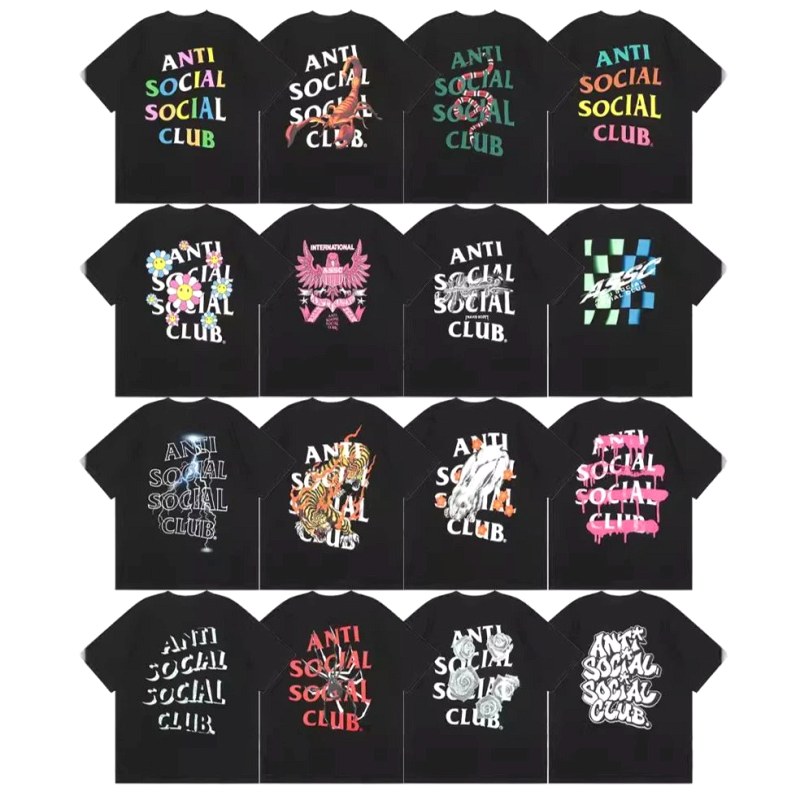
SKU 7718733486 is a $6.87 loose-fit tee from Anti Social Social Club, offered in S through XXL across a dropdown of 66 colourway entries: the numbered cherry-blossom print series from 01 up to 29, mostly on black and white bases, with a few grey and burgundy variants. Our desk ordered size M in print 27 on black through a shopping agent and put it through the standard intake routine: bench measurements, stitch counts at two seams, care label against the stated composition, then one wash cycle at the temperature printed on the label.
The reason this one went to the bench at all is a line in the specification table. Read quickly, the listing calls the top both collarless and crew neck. Those are not the same claim, and the difference matters when you are buying a graphic tee you cannot try on. So we started at the neckline.
What "collarless" actually describes here
The parcel arrived with a ribbed neckband, not a bare folded edge and not a fold-over shirt collar. Measured flat, the band is 2.0 cm deep in a 1×1 rib, joined with a visible seam at the back of the neck. In the source specification, "collarless" is a garment-structure field describing the absence of a separate shirt collar; the crew-neck field describes the neckline shape. Both are technically true of the same garment.
For a buyer this resolves into something practical: you are getting a proper ribbed crew neck with a taped-ish back join, which is what holds the neckline shape through washing. A genuinely collarless tee — raw or simply overlocked at the opening — would gape and ripple after a few wears. This one does not. On our sample the neckband recovered its shape fully after the wash cycle, and the join showed no puckering.
Owners of the brand's tees are blunt about care: "You should only hand wash the shirts ... Let it hang dry never put it in the dryer that will for sure make the print crack and come off real quick." That advice is consistent with what the print feels like on the bench.
Bench measurements, size M, flat and unwashed
| Check | Our measurement | Listing figure |
|---|---|---|
| Chest, pit to pit | 56.0 cm | 55 cm |
| Body length, high point shoulder to hem | 71.0 cm | 70 cm |
| Raglan seam, neck point to cuff | 33.5 cm | 32 cm ("sleeve length") |
| Underarm to cuff | 20.0 cm | not stated |
| Hem width, flat | 57.0 cm | not stated |
| Neckband depth | 2.0 cm, 1×1 rib | not stated |
| Weight | 231 g | weight field shows 0.00 |
| Chest print block | 24 × 16 cm | not stated |
Every figure sits inside the listing's declared 1–3 cm tolerance, so nothing here is a mismatch. The complication is measuring method, not accuracy.
A raglan sleeve has no shoulder seam to measure from
The listing specifies raglan short sleeves, and the flat-lay photos show the diagonal seam running from the neck to the underarm. That single construction choice invalidates two of the numbers most people use to pick a size.
- Shoulder width. There is no shoulder seam, so a shoulder-width figure can only be a cross-back measurement taken between the two armhole points. If a size chart prints a shoulder number without saying so, you cannot compare it with a tee that has regular set-in sleeves.
- Sleeve length. On a raglan, sleeve length is conventionally taken along the diagonal seam from the neck point to the cuff. Ours measured 33.5 cm that way and 20.0 cm from underarm to cuff. The chart's 32 cm is close to the first convention and far from the second. If you compare the wrong pair, a short sleeve reads as a long one.
Where this bites is the brand's documented sizing inconsistency: buyer reports range from "size up at least one" to "true to size or slightly big," and some of that spread is almost certainly people comparing different measuring points across different drops. On a raglan loose-fit tee, ask the agent for the flat measurement of the specific colourway in your size before the parcel ships, and state which point you want measured.
Fabric, stitch density and the blank weight field
The listing specifies double-yarn cotton, standard thickness, 230 g/m², pullover, printed finish, loose fit. Our size M came in at 231 g on the bench scale, which supports the gramme claim rather than undercutting it — a mid-weight knit, not a paper-thin blank. The hand is dry and slightly crisp rather than brushed-soft, which is what you expect from a double-yarn knit at this weight with a print on it.
We counted stitches at two places. The hem coverstitch runs about 11 stitches per inch; the neckband join about 12. Neither is a luxury-garment count, but both are even, with no skipped stitches or wandering seam allowance, and the side seam is a clean four-thread overlock. At this price the construction is the strongest part of the product.
One field on the listing is simply blank: weight reads 0.00. That is not a shipping estimate and should not be treated as one. Add roughly 100–150 g for a mailer or box plus any consolidation, and confirm the parcel weight from the agent's pre-shipment scale photo rather than from the listing.
Print behaviour, the label, and one wash cycle
The chest graphic is a raised plastisol-style print, roughly 0.2 mm proud of the fabric, with a geometric motif and lettering. Edges are sharp and registration holds across the panel; we found no bleed into the base cloth on the black colourway. The care label reads 100% cotton, machine wash at 30 °C, line dry, and does not invite ironing over the print — consistent with the stated composition.
We washed once at 30 °C and line-dried, then re-measured. Length went from 71.0 to 69.8 cm and chest from 56.0 to 55.0 cm, a loss of about 1.2 cm and 1.0 cm — inside the declared tolerance and not enough to change the fit of a loose tee. The print showed no cracking or lifting at the edges after that single cold cycle. Heat is the documented risk, not water: owners report the graphics crack and peel in a dryer, and some buyers describe the blanks as thin for the brand name. We did not run a tumble cycle on this sample, so treat high-heat durability as an open question rather than a settled one.
How to order one
Pick the print number first, then the base colour, then the size — the dropdown carries 66 entries and the numbering does not run in a clean sequence, so it is easy to land on 27 grey when you meant 27 black. Send the agent your three flat measurements in writing: pit to pit, high point shoulder to hem, and raglan seam from neck point to cuff. Then check the QC photos for print alignment on the panel and for a neckband that sits flat. And plan for handling time, because the brand's history of long processing is documented and the listing will not shorten it.